Why the Galápagos Islands Are a True Natural Paradise for Travelers
@naturalparadisegalapagosfacts
November 4, 2026 · 6 min read
Few places on earth manage to feel both ancient and immediate, remote yet accessible, all at once. The Galápagos Islands have that quality. They sit roughly six hundred miles off the coast of Ecuador, a volcanic archipelago where time seems to move at its own pace. For anyone drawn to raw landscapes and wildlife that shows no fear of humans, this is a destination that delivers something rare: a sense of discovery that hasn't been dulled by crowds or commercialization.
What makes the Galápagos a natural paradise galápagos in the truest sense is not just the famous species, though those are extraordinary. It is the way the entire ecosystem functions as a living laboratory. Charles Darwin spent only five weeks here in 1835, but his observations reshaped how we understand life on earth. Standing on a lava field on San Cristóbal or watching a marine iguana sneeze salt from its nostrils on Santa Cruz, you feel the continuity of that natural experiment. The islands remain a UNESCO World Heritage site for good reason. They are protected, but not fenced off. You walk the same trails, paddle the same coves, and float above the same reefs that have drawn scientists and travelers for nearly two centuries.
What Sets This Archipelago Apart
The Galápagos consist of thirteen major islands, six smaller islands, and dozens of islets. Only a handful are inhabited. The rest are national park land, managed by Ecuador with strict regulations on where visitors can go and how many can land each day. That management is what keeps the experience intact. You do not find souvenir stalls at the trailhead. You do not see trash along the shoreline. The rules are simple: stay on the marked path, keep at least two meters from the wildlife, and leave nothing behind.
Each island has its own character. Bartolomé, a small island near the center of the archipelago, offers a short but steep climb to a viewpoint that overlooks a bay shaped like a perfect crescent. The volcanic landscape is stark, almost lunar, and the silence up there is punctuated only by the wind and the occasional call of a passing frigatebird. On the other end of the spectrum, Santa Cruz is the hub of tourism, with Puerto Ayora as its main port. Here, you find the Charles Darwin Research Station, a working facility where scientists study giant tortoise breeding programs and invasive species management. It is also where you can see the famous Lonesome George, the last known Pinta Island tortoise, preserved and displayed as a reminder of what conservation efforts aim to prevent.

Wildlife Encounters That Feel Personal
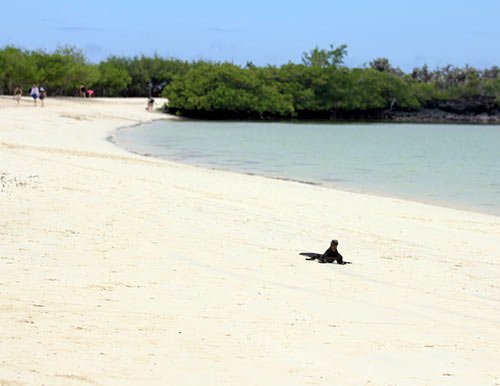
Most visitors come for the animals, and the animals deliver. Sea lions lounge on benches and swim right up to snorkelers, treating humans as curious playmates. Blue-footed boobies perform their courtship dance on the trails, lifting one bright foot after the other with the kind of deliberate precision that makes you forget you are watching a bird. Marine iguanas, the only lizards in the world that forage in the ocean, line the rocky shores like small dragons sunning themselves after a meal of algae.
The giant tortoise is the emblem of the islands, and seeing one in the wild is a quiet, humbling experience. On Santa Cruz and Isabela, you can walk through highland areas where these slow giants move along ancient paths, grazing on grass and cactus pads. They are not in a hurry, and neither should you be. Watching a tortoise for ten minutes reveals more about patience and adaptation than any documentary can capture.
Snorkeling and kayaking are the best ways to see marine life up close. The water is cool but clear, and the currents around islands like Bartolomé and San Cristóbal bring nutrient-rich water that supports everything from sea turtles to schools of hammerhead sharks. A panga ride, the small inflatable boats used for shore landings, can take you to hidden coves where the only sounds are the splash of oars and the exhale of a surfacing sea lion. Some excursions also use a glass-bottom boat, which offers a window into the underwater world without getting wet. That option works well for those who prefer to stay dry, though nothing beats floating face-down in the same water as a penguin zipping past.
The Role of a Luxury Yacht in This Setting
Given the remote nature of the islands, getting around requires a boat. Many travelers choose a live-aboard experience, and a luxury yacht like the Natural Paradise offers a way to explore the archipelago with comfort and flexibility. With only a small number of guests on board, the experience becomes personal. Guides are local naturalists who know the islands intimately, and itineraries can adjust to weather, wildlife activity, and the interests of the group.
The phrase natural paradise galápagos takes on a specific meaning in this context. It is not just about the scenery, though the scenery is remarkable. It is about traveling in a way that respects the fragility of the place while still allowing you to immerse yourself in it. A small vessel means fewer people on the trails, less impact on the sites, and more time to absorb what you are seeing. You can spend a morning kayaking along the cliffs of Isabela, then return to the yacht for a meal prepared with local ingredients, all while the boat moves overnight to the next destination.
Practical Considerations for Your Trip
Getting to the Galápagos requires flying into either Baltra or San Cristóbal from mainland Ecuador. From there, you transfer to your boat or to a hotel in Puerto Ayora. The national park charges an entrance fee, and all visitors must be accompanied by a licensed guide. That guide system is one of the reasons the islands remain so well preserved. Guides control the pace, enforce the rules, and provide context that makes the difference between a nice walk and a meaningful experience.
Packing for the Galápagos means preparing for sun, wind, and occasional rain. Layers work best. A good pair of walking shoes is essential for the lava rock trails. Reef-safe sunscreen is required, and a rash guard makes snorkeling more comfortable. Binoculars help with birdwatching, especially for spotting finches and mockingbirds that vary from island to island.
Timing matters. The warm season, from December to May, brings calmer seas and better visibility for snorkeling. The cool season, June to November, means stronger winds and rougher water, but also more active marine life and easier sightings of whale sharks. Both seasons have their advantages, and neither is a bad choice.

Why It Stays With You
The Galápagos Islands do not need hype. They have been a natural paradise galápagos since long before anyone wrote the phrase. What they offer is a chance to step outside the familiar and into a world where the rules are different. The animals do not run away. The landscape does not hide its volcanic origins. The water is full of life, and the sky is full of birds. For anyone who values wild places that have not been tamed, this archipelago remains one of the last great destinations where the journey itself is the reward.